

Spm Additional Mathematics Formula List Pdf
Successfully reported this slideshow.
Chapter 9 differentiation
 1
1
Like this document? Why not share!
- 79 Likes
- Statistics
- Notes
Chapter 9 differentiation
- 1. Additional Mathematics Module Form 4 Chapter 9- Differentiation SMK Agama Arau, Perlis Page | 105 CHAPTER 9- DIFFERENTIATION 9.1 LIMIT OF A FUNCTION Example 1: )2(lim 2 + → x x = 2 + 2 = 4 Brief explaination: y 4 2 0 2 x 1. If x is not 2 but 1.9, 1.99 and 1.999, the value of y gets nearer and nearer to 4 but it does not exceed 4. 2. It is also just the same if the value of x is 2.1, 2.01, 2.001, the value of y gets nearer and nearer to 4 but it does not exceed 4. 3. In this situation, we can say that 2+x approaches 4 as x approaches 2 or 4)2(lim 2 =+ → x x 4. Hence, the function 2+= xy has limit 4 as 2→x . Example 2: 2 4 lim 2 2 − − → x x x )2( )2)(2( lim 2 − −+ → x xx x )2(lim 2 + → x x 22 += 4= 2+= xy First of all, factorize the numerator first. Then simplify.
- 2. Additional Mathematics Module Form 4 Chapter 9- Differentiation SMK Agama Arau, Perlis Page | 106 Example 3: ) 1 (lim x x x + ∞→ ) 1 (lim xx x x += ∞→ ) 1 1(lim xx += ∞→ 01+= 1= EXERCISE 9.1 Find: (a) 2 2 23 lim x x x + ∞→ (b) )32(lim 1 + → x x (c) 2 5 2lim x x→ (d) 3 9 lim 2 4 − − → x x x 9.2 FIRST DERIVATIVE OF A FUNCTION 9.21 GRADIENT OF THE TANGENT TO A CURVE AND THE FIRST DERIVATIVE OF A FUNCTION 1. Tangent to a curve is a line which is just touching the curve and not cut the curve. 2. The gradient of the tangent to a curve can be determined by finding the small changes in y divided by small changes in x. Brief explaination: Q(1.1,2.4) P(1,2) 1. When the point Q is move nearer and neared to the point P, there will be a point which is very near to point P but not the point P and there is a very small change in value of x and y at the point from point P. 2. The point and the point P are joined in a line that is the tangent of the curve. We know that any number that divided by zero will result infinity. For example: ∞= 0 1 . So if we can change the equation to be like this 0 1 = ∞ that is 1 divided by will result zero. For this question, at first we have to separate the terms into two fractions. Then simplify for the terms that can be simplified. Substitute x= ∞ into x 1 and becomes ∞ 1 . We know that 0 1 = ∞ . o o
- 3. Additional Mathematics Module Form 4 Chapter 9- Differentiation SMK Agama Arau, Perlis Page | 107 2. The small change in y is the difference in value of y between the point and point P while the small change in x is the difference between the value of x of the point and point P. 3. Small changes in y can be written as yδ that is read as "delta y" while small changes in x can be written as xδ that is read as "delta x". Q(x+ xδ , y + yδ ) yδ P(x, y) xδ x+ xδ 4. From the graph above, we know that x y mPQ δ δ = . 5. But at point P, x y m x P δ δ δ 0 lim → = 6. x y x δ δ δ 0 lim → is the gradient of tangent at point P. 7. To write x y x δ δ δ 0 lim → , it is a quite long, so we can write them as dx dy . 8. dx dy is differentiation. 9.22 DIFFERENTIATION BY THE FIRST PRINCIPLE Q( x+ xδ , y + yδ ) P(x, y) 2 xy = 22 2 2 )( xxxxyy xxyy δδδ δδ ++=+ +=+ 2 xy = 1 2 The both points lie on the same curve, so they can be solved simultaneously. Tangent to the curve This graph show the point Q that very close to point P that has moved nearer to point P o o o o
- 4. Additional Mathematics Module Form 4 Chapter 9- Differentiation SMK Agama Arau, Perlis Page | 108 - , xx x y xx x y x xxx x y xxxy xxxxxyyy xx δ δ δ δ δ δ δ δδ δ δ δδδ δδδ δδ += += + = += −++=−+ →→ 2limlim 2 2 2 2 00 2 2 222 x dx dy 2= EXERCISE 9.20 Find dx dy of the following equation using the first principle. (a) 2 3xy = (b) 52 2 += xy (c) x y 2 = (d) x y 3 5 −= (e) 2 31 xy −= (f) xxy 53 2 −= - Finding dx dy by using formula - n axy = Given that y = f(x), The first derivate dx dy is equivalent to )(' xf , That is if n axxf =)( , Then, )( )( ' xf dx xdf = 2 1 1 .. − = n xna dx dy Left hand side and right hand side are divided by xδ to make the term x y δ δ . The right hand side is then simplified. For left hand side, we already know that x y x δ δ δ 0 lim → can be converted into dx dy . For right hand side, the value of xδ is replacing by zero. When Q approaches P, there is no change in x or xδ approaches 0. 1 ..)(' − = n xnaxf If the 2 xy = , then x dx dy 2= . If 2 )( xxf = , then xxf 2)(' = If xy 2= 2 )2()( = = dx dy x dx d y dx d If xxf 2)( = 2)(' 2 )( )2()]([ = = = xf dx xdf x dx d xf dx d
- 5. Additional Mathematics Module Form 4 Chapter 9- Differentiation SMK Agama Arau, Perlis Page | 109 Example 1: 2 xy = )( 2 x dx d dx dy = 12 .2.1 − = x dx dy x dx dy 2= Example 2: xxf xxxf xxf 6)(' .0.6.2.3)(' 63)( 1012 2 = += += −− EXERCISE 9.21 1. Find dx dy for each of the following equation. Hence, find the value of dx dy at point where 2=x . (a) 42 4 −= xy (b) )5( 2 += xxy (c) 2 2 2 x xx y + = 2. Find )(' xf for each of the following functions. Hence, find the value of )3('f . (a) xxxf 3)( 2 += (b) 2 )12()( −= xxf (c) )3)(22()( −−= xxxf 9.3.1 Differentiate expression with respect to x Example 1: Differentiate 4 2 1 4 −x with respect to x. Solution: )4 2 1 ( 04 xx dx d − 1014 4.0 2 1 .4 −− −= xx 3 2x= We add the terms x0 because to do differentiation, it involves x if it is respect to x. x0 = 1. When differentiate the terms without the variable or unknown, it will result zero. Tips… Compare the solution by using formula and by using the first principle. We get the same answer for the same equation. We cannot change the expression into an equation and then differentiate it. The solution must be started with )4 2 1 ( 4 −x dx d , cannot with 4 2 1 4 −x .
- 6. Additional Mathematics Module Form 4 Chapter 9- Differentiation SMK Agama Arau, Perlis Page | 110 Example 2: Differentiate )32)(32( +− xx with respect to x. x xx xx dx d xx dx d 8 .9.0.4.2 )94( )]32)(32[( 1012 02 = −= − +− −− EXERCISE 9.22 Differentiate each of the following with respect to x. (a) 53 2 −x (b) x x 22 − (c) )43)(43( +− xx 9.3 FIRST DERIVATIVE OF COMPOSITE FUNCTION Example 1: Find dx dy for the function 2 )12( += xy Solution: Method 1 2 )12( += xy 144 2 ++= xxy Method 2 2 )12( += xy Let 12 += xu 2= dx du 2 uy = First of all, expand the bracket. Then differentiate the expression. We add the terms x0 because to do differentiation, it involves x if it is respect to x. x0 = 1. 48 += x dx dy We know the value du dy and dx du , but we have to find dx dy . So we have to use the concept below. First of all, expand the bracket. Then differentiate it
- 7. Additional Mathematics Module Form 4 Chapter 9- Differentiation SMK Agama Arau, Perlis Page | 111 u du dy 2= 22 ×= u dx dy u4= )12(4 += x 48 += x Brief Explaination: From the second method above, the concept to differentiate it is: 1. Consider the expression in the bracket as a term such as u but cannot x. Then differentiate it. 2 uy = u du dy 2= 2. Then, differentiate the part in the bracket. 12 += xu 2= dx du 3. Multiply both of them and it will result dx dy . 4. We can use the method 2 in all situations easily but method 1 can be used easily in certain situations only that is the number of power is small such as 2. Example 2: Find dx dy for the function 5 )43( += xy Let 43 += xu 3= dx du 5 uy = 4 5u du dy = dx du du dy dx dy ×= If we simplify dx du du dy dx dy ×= at right hand side, it will result dx dy . This is called chain rule. We can use method 1 to differentiate if the number of power is small such as 2. But, if it is the power of 4, 5 and above, we can still use the method 1 but it is very complicated to solve but it is easy to differentiate by using the method 2. Tips… We are not supposed to use method 1. It is quite complicated have to expand the bracket because it is the power of 5. So we can use the method 2.
- 8. Additional Mathematics Module Form 4 Chapter 9- Differentiation SMK Agama Arau, Perlis Page | 112 35 4 ×= u dx dy 4 15u= 4 )43(15 += x We can also write directly like this: 3.)43(5 15− += x dx dy 4 )43(15 += x EXERCISE 9.3 Find dx dy for each of the following equation. (a) 4 )31( xy −= (b) 3 ) 1 1( x y += (c) 4 )53( 1 − = x y 9.4 FIRST DERIVATIVE OF TWO POLYNOMIALS 9.41 FIRST DERIVATIVE OF THE PRODUCT OF TWO POLYNOMIALS )1)(12( ++= xxy u v uvy = vuuvvuuvyy vvuuyy δδδδδ δδδ +++=+ ++=+ ))(( Substitute 43 += xu into 4 15u dx du du dy dx dy ×= 2 1 How to get the formula?
- 9. Additional Mathematics Module Form 4 Chapter 9- Differentiation SMK Agama Arau, Perlis Page | 113 - , , )(limlim 00 x vu x uv x vu x y x vu x uv x vu x y x vuuvvu x y vuuvvuy uvvuuvvuuvyyy dxdx δ δδ δ δ δ δ δ δ δ δδ δ δ δ δ δ δ δ δδδδ δ δ δδδδδ δδδδδ ++= ++= ++ = ++= −+++=−+ →→ x v u x u v x v u x y dxdxdxdxdxdxdx δ δ δ δ δ δ δ δ δ 0000000 limlimlimlimlimlimlim →→→→→→→ ×××××= dx dv dx du v dx dv u dx dy .0++= Example: Find dx dy for the function )1)(12( ++= xxy )1)(12( ++= xxy u v 1 1 2 12 = += = += dx dv xv dx du xu The formula is dx du v dx dv u dx dy += , just substitute each term into the formula to find dx dy )2)(1()1)(12( +++= xx dx dy 34 2212 += +++= x xx 2 1 dx du v dx dv u dx dy +=
- 10. Additional Mathematics Module Form 4 Chapter 9- Differentiation SMK Agama Arau, Perlis Page | 114 EXERCISE 9.40 1. Find dx dy for each of the following equation. Hence, find the value of dx dy at point where 1−=x . (a) )2)(31( +−= xxy (b) 2 )3)(2( −+= xxy (c) 32 )2()3( ++= xxy 2. Find )(' xf for each of the following functions. Hence, find the values of )1('f and 2 )2(' −f (a) )3)(52()( ++= xxxf (b) 5 )4)(12()( +−= xxxf (c) 24 )3()22()( −−= xxxf 9.4.2 Differentiate expression with respect to x Example: Differentiate 42 )52(3 −xx with respect to x. 42 )52(3 −xx u v 2.)52(4 )52( 6 3 3 4 2 −= −= = = x dx dv xv x dx du xu 3 )52(8 −= x )56()52(6 )]52(4[)52(6 )52(6)52(24 6.)52()52(8.3 ])52(3[ 3 3 432 432 42 −−= −+−= −+−= −+−= − xxx xxxx xxxx xxxx xx dx d If it is given an equation, the formula used is dx du v dx dv u dx dy += . If it is given an expression not equation, the formula used is just dx du v dx dv u + without equal sign because it is an expression not an equation. Factorize
- 11. Additional Mathematics Module Form 4 Chapter 9- Differentiation SMK Agama Arau, Perlis Page | 115 EXERCISE 9.41 Differentiate each of the following with respect to x. (a) 3 )42)(53( xx −− (b) 53 )65(4 −xx (c) 43 )4()98( +− xx 9.42 FIRST DERIVATIVE OF THE QUOTIENT OF TWO POLYNOMIALS 1 12 + + = x x y v u y = vv uu yy δ δ δ + + =+ - , , + − = + − = × + − = + − = + −−+ = + + − + + = − + + =−+ →→ )( limlim )( 1 )( )( )( )( )( )( )( 00 vvv x v u x u v x y vvv x v u x u v x y xvvv vuuv x y vvv vuuv y vvv vuuvuvuv y vvv vvu vvv uuv y v u vv uu yyy dxdx δ δ δ δ δ δ δ δ δ δ δ δ δ δ δδ δδ δ δ δ δδ δ δ δδ δ δ δ δ δ δ δ δ δ u v 2 2 1 1 How to get the formula?
- 12. Additional Mathematics Module Form 4 Chapter 9- Differentiation SMK Agama Arau, Perlis Page | 116 )(limlim limlimlimlim )( lim 00 0000 0 vvv x v u x u v vvv x v u x u v dxdx dxdxdxdx dx δ δ δ δ δ δ δ δ δ δ +× ×−× = + − = →→ →→→→ → vv dx dv u dx du v dx dy . − = Example: Find dx dy for the function 1 12 + + = x x y by using formula 2 v dx dv u dx du v dx dy − = . 1 1 2 12 = += = += dx dv xv dx du xu Substitute each term into the formula to find dx dy , 2 )1( )1)(12()2)(1( + +−+ = x xx dx dy 2 2 2 )1( 3 )1( 1222 )1( )12()1(2 + = + +−+ = + +−+ = x x xx x xx 2 v dx dv u dx du v dx dy − =
- 13. Additional Mathematics Module Form 4 Chapter 9- Differentiation SMK Agama Arau, Perlis Page | 117 EXERCISE 9.42 1. Find dx dy for each of the following equation. Hence, find the value of dx dy at point where 1=x . (a) ( ) 52 23 2 − + = x x y (b) ( ) ( )2 3 1 12 + + = x x y (c) ( ) ( )3 2 74 65 − − = x x y 2. Find )(' xf for each of the following functions. Hence, find the values of )1('f and 2 )5('f (a) 52 2 )( 2 − + = x xx xf (b) ( ) 52 23 3 − + = x x y (c) ( ) xx x y 52 23 2 2 − + = 9.4.3 Differentiate expression with respect to x Example: Differentiate 1 23 2 + + x xx with respect to x. 1 1 26 23 2 = += += += dx dv xv x dx du xxu + + 1 23 2 x xx dx d 2 2 )1( )1)(23()26)(1( + +−++ = x xxxx 2 22 )1( 23286 + +−++ = x xxxx If it is given an equation, the formula used is 2 v dx dv u dx du v dx dy − = . If it is given an expression not equation, the formula used is just 2 v dx dv u dx du v − without equal sign because it is an expression not an equation.
- 14. Additional Mathematics Module Form 4 Chapter 9- Differentiation SMK Agama Arau, Perlis Page | 118 2 2 )1( 2103 + ++ = x xx EXERCISE 9.43 Differentiate each of the following with respect to x. (a) 23 32 − + x x (b) 2 3 4 x xx + (c) 12 5 2 +x x 9.5 TANGENT AND NORMAL TO THE CURVE 1. Tangent to a curve is a line which is just touching the curve and not cut the curve. 2. Normal to a curve is a straight line perpendicular to the tangent at same point on the curve as shown in the figure above. Hence, since the both straight lines are perpendicular to each other, 1tan −=× normalgent mm 3. We have learned that dx dy is the gradient of tangent. So, when we are going to find the gradient of normal, at first we have to find the gradient of tangent. 4. If it is given the gradient of normal, we can find the gradient of the tangent by using formula above. Normal to the curve Tangent to the curve
- 15. Additional Mathematics Module Form 4 Chapter 9- Differentiation SMK Agama Arau, Perlis Page | 119 Example 1: Find the equation of the tangent and the equation of normal to the curve 592 2 −−= xxy at the point (3, 4) Solution: 94 592 2 −= −−= x dx dy xxy At point (1, 3), 9)3(4 −= dx dy 3 912 = −= Gradient of tangent is 3. 3 1 13 1tan −= −=× −=× normal normal normalgent m m mm The equation of the tangent at (3, 4) is 63 933 3 3 3 −= −=− = − − xy xy x y The equation of the normal at (3, 4) is 0123 393 3 1 3 3 =−+ −=− −= − − yx xy x y We have learned that to find the gradient, we use the formula 12 12 2− − x yy . Use the point (x, y) that is as a general point and given point (3, 4). Substitute the value of x into the equation to find the gradient of tangent at point (1, 3)
- 16. Additional Mathematics Module Form 4 Chapter 9- Differentiation SMK Agama Arau, Perlis Page | 120 Example 2: Find the equation of normal to the curve 243 2 +−= xxy that is parallel to the line 52 =− xy . Solution: 46 243 2 −= +−= x dx dy xxy 2 5 2 1 52 += =− xy xy m = 2 1 normalm is parallel to this line, so 2 1 =normalm . 2 1 2 1 1 tan tan tan −= −=× −=× gent gent normalgent m m mm We know that 46 −= x dx dy and 2tan −=gentm , hence 3 1 246 = −=− x x 2tan −=gentm and 2 1 =normalm at point which 3 1 =x . 243 2 +−= xxy 3 1 =x , 2 3 1 4 3 1 3 2 + − =y 1= We do not know any point so we cannot find the gradient of tangent at the moment . Given that the gradient of normal is equal to the gradient of this line. So we can find the gradient of normal. Normal to a curve is a straight line perpendicular to the tangent. We know the gradient of normal, so we can find the gradient of tangent. At the early of the solution, we got 46 −= x dx dy that is the gradient of tangent. From the gradient of normal, we got the gradient of tangent. So compare these two equations We are going to find the value of y for this point that results the gradient of tangent and normal are -2 and 2 1 respectively. We substitute the value of x into the equation of the curve that is 243 2 +−= xxy to find the value of y.
- 17. Additional Mathematics Module Form 4 Chapter 9- Differentiation SMK Agama Arau, Perlis Page | 121 Hence the point is 1, 3 1 . The equation of the normal at 1, 3 1 is 0563 1366 3 1 22 2 1 3 1 1 =+− −=− −=− = − − yx xy xy x y EXERCISE 9.5 Find the equation of tangent and the equations of normal for each of the following functions at given points: (a ) xxxy 46 23 +−= ; 3=x (b) 2 )3)(2( −+= xxy ; 2−=x (c) 23 32 − + = x x y ; 1=x 9.6 SECOND ORDER DIFFERENTIATION 1. First differentiation is dx dy . 2. Second order differentiation is 2 2 dx yd that is we differentiate for the second times. Example 1: Given xxxy 46 23 +−= ,find 2 2 dx yd . 126 4123 46 2 2 2 23 −= +−= +−= x dx yd xx dx dy xxxy Multiply the equation by 3 Differentiate one more time dx d dx dy = 2 2 dx yd
- 18. Additional Mathematics Module Form 4 Chapter 9- Differentiation SMK Agama Arau, Perlis Page | 122 Example 1: Given x xxxf 1 4)( 3 ++= ,find )('' xf . 3 '' 3'' 22' 13 3 2 6)( 26)( 143)( 4)( 1 4)( x xxf xxxf xxxf xxxxf x xxxf += += −+= ++= ++= − − − EXERCISE 9.6 1. Find 2 2 dx yd for each of the following equation. Hence, find the value of 2 2 dx yd at point where 1=x . (a) xxy 52 4 −= (b) )5(2 2 xxxy += (c) 2 2 32 x xx y + = 2. Find )('' xf for each of the following functions. (a) xxxf 3)( 2 += (b) 2 )23()( −= xxf (c) 3 )3)(24()( −−= xxxf 9.7 CONCEPT OF MAXIMUM AND MINIMUM VALUES y C D A B x 1. Based on the graph above: (a) A and C are maximum points (b) B and D are minimum points (c) A, B, C and D are turning points If )( )( ' xf dx xdf = , then )( )( '' 2 2 xf dx xfd = Differentiate one more time
- 19. Additional Mathematics Module Form 4 Chapter 9- Differentiation SMK Agama Arau, Perlis Page | 123 2. At turning points, 0= dx dy 3. This is because the line of the tangent at the turning points is a horizontal line that is parallel to x-axis which is the gradient is 0. dx dy is the gradient of tangents so at at turning points, 0= dx dy . 9.6.1 Steps to determine a turning point is maximum or minimum 1- Find dx dy 2- Determine the turning points, find the value of x then find the value of y 3- Determine whether the turning point (x, y) is maximum or minimum. (a) minimum point: x <x1 x1 >x1 dx dy negative 0 positive Sketch position of tangent Shape of the graph (b) maximum point: x <x1 x1 >x1 dx dy positive 0 negative Sketch position of tangent Shape of the graph Example 1: Find the turning point for the function 593 23 +−−= xxxy . Hence, state each point is minimum or maximum. Solution: Method 1 963 593 2 23 −−= +−−= xx dx dy xxxy
- 20. Additional Mathematics Module Form 4 Chapter 9- Differentiation SMK Agama Arau, Perlis Page | 124 At turning point, 0= dx dy . 0)3)(1( 032 0963 2 2 =−+ =−− =−− xx xx xx 1−=x or 3=x (i) 1−=x 5)1(9)1(3)1( 23 +−−−−−=y (-1, 10) 10= (ii) 3=x 5)3(9)3(3)3( 23 +−−=y (3, -22) 2=y The turning points are (-1 , 10) and (3,-22) (i) (i) 2−=x 15 9)2(6)2(3 2 = −−−−= dx dy dx dy (i) 0=x So, the point (-1, 10) is a maximum point. (ii) (i) 2=x 9 9)2(6)2(3 2 = −−= dx dy dx dy (i) 4=x So, the point (3, -22) is a minimum point. x <-2 -1 0 dx dy positive 0 negative Sketch position of tangent Shape of the graph x 2 3 4 dx dy negative 0 positive Sketch position of tangent Shape of the graph 9 9)0(6)0(3 2 −= −−= dx dy dx dy 15 9)4(6)4(3 2 = −−= dx dy dx dy Factorize to find the values of x Substitute the value of x into the equation of the curve that is 593 23 +−−= xxxy to find the value of y. Use the first value of x that is -1. Take a value that is greater than -1 such as 0 and a value that is less than -1 such as -2. Then solve it to find out either it is a maximum or minimum point. For the second value of x that is 3, repeat the same steps to find out either it is a maximum or minimum point.
- 21. Additional Mathematics Module Form 4 Chapter 9- Differentiation SMK Agama Arau, Perlis Page | 125 Method 2 963 593 2 23 −−= +−−= xx dx dy xxxy At turning point, 0= dx dy . 0)3)(1( 032 0963 2 2 =−+ =−− =−− xx xx xx 1−=x or 3=x (i) 1−=x 5)1(9)1(3)1( 23 +−−−−−=y (-1, 10) 10= (ii) 3=x 5)3(9)3(3)3( 23 +−−=y (3, -22) 2=y The turning points are (-1 , 10) and (3,-22). 963 2 −−= xx dx dy 662 2 −= x dx yd At point (-1, 10), 6)1(62 2 −−= dx yd 12−= 02 2 < dx yd (-1, 10) is a maximum point At point (3, -22), 6)3(62 2 −= dx yd 12= To find the coordinates of the turning points. Substitute the value of x into the equation 593 23 +−−= xxxy to find the value of y. Factorize to find the values of x Differentiate one more time If 02 2 < dx yd , then it is a maximum value. If 02 2 > dx yd , then it is a minimum value. Tips…
- 22. Additional Mathematics Module Form 4 Chapter 9- Differentiation SMK Agama Arau, Perlis Page | 126 02 2 > dx yd (3, -22) is a minimum point. EXERCISE 9.7 1. Find the turning point for each of the following function. Hence, state each point is minimum or maximum. (a ) x xy 1 += (b) 2 2 16 )( x xxf += 2. Find the turning point at the following curve (a ) 2 8 xxy −= (b ) 2 2 96 2)( x xxf += 9.8 RATE OF CHANGE 1. The first derivative for a function denotes the change in the quantity y with respect to the change in the quantity x. 2. Rate of change is differentiation that is respect to time dt d 4. The formula for rate of change is where A and B are variables that can be changes depends on the case and situation. Example 1: The sides of a cube increases at the rate of 1.4cms-1 . Find the rate of change of the volume when the sides measure 5 cm. Solution: In this case, A is the volume (V) and B is the side(s). Given that 1 4.1 − = cms dt ds , cms 5= and 3 sV = . We are going to find dt dV . 2 3 3s ds dV sV = = dt dB dB dA dt dA ×= 3 sV = is the formula for the volume of cube. Differentiate it that is respect to s.
- 23. Additional Mathematics Module Form 4 Chapter 9- Differentiation SMK Agama Arau, Perlis Page | 127 The formula is dt ds ds dV dt dV ×= Substitute 2 3s ds dV = into the formula. dt ds s dt dV ×= )3( 2 When 1 4.1 − = cms dt ds , 5=s , 4.1)5(3 2 ×= dt dV 13 105 4.175 − = ×= scm Example 2: The volume of a sphere decreases at the rate of 13 4 − scm . Find the rate of change of the radius of sphere when the radius is 3cm. Solution: In this case, A is the volume (V) and B is the radius (r). Given that 13 4 − −= scm dt dV , cmr 3= and 3 3 4 rV π= . We are going to find dt dr . 2 3 4 3 4 r dr dV rV π π = = The formula is dt dr dr dV dt dV ×= Substitute 2 4 r dr dV π= into the formula, dt dr r dt dV ×= 2 4π Substitute the value of r that is 5 into 3s2 and the value of dt ds into the formula. 3 3 4 rV π= is the formula for the volume of sphere. Differentiate it that is respect to r. The value of dt dV is negative because the rate is decreasing. If it is increasing, it will be positive. Info…
- 24. Additional Mathematics Module Form 4 Chapter 9- Differentiation SMK Agama Arau, Perlis Page | 128 When 13 4 − −= scm dt dV , cmr 3= , 1 2 36 4 )3(44 −− = ×=− cms dt dr dt dr π π 1 9 1 − −= cms π EXERCISE 9.8 1. The area of a circular water ripple expands at the rate of 12 6 − scm when the radius is 5 cm. Hence, find the rate of change of the radius if the ripple. 2. Given that x xy 4 5 += . If y increases at a constant rate of 3 unit per second, find the rate of change of x when x= 4. 9.9 SMALL CHANGE AND APPROXIMATION 1. We have learned that delta x( xδ ) is the small change in x and delta y( yδ ) is the small change in y. 2. We know that x y x δ δ δ 0 lim → = dx dy . 2. The formula for small change and approximation is Where x and y are variables that can be changes depends on the case and situation. Example 1: Given the radius of a circle increases from 4cm to 4.01.cm. Find the approximate change in its area. Solution: In this case, A is the area (A) and B is the radius (r). Given that cmr 01.0=δ , cmr 4= and 2 rA π= . We are going to find Aδ . r dr dA rA π π 2 2 = = dx dy x y ≈ δ δ Substitute the value of r that is 3 into 2 4 rπ and the value of dt dV into the formula. 2 rA π= is the formula for the area of circle. Differentiate it that is respect to r.
- 25. Additional Mathematics Module Form 4 Chapter 9- Differentiation SMK Agama Arau, Perlis Page | 129 The formula is dr dA r A ≈ δ δ Substitute r dr dA π2= into the formula, r r A π δ δ 2≈ rrA δπδ ×≈ 2 When cmr 01.0=δ , cmr 4= , )01.0()4(2 ×≈ πδA )01.0(8 ×≈ π 2 08.0 cmπ≈ Example 2: Given 43 2 += xy . Find the approximate change in y when x increases from 2 to 2.03. Solution: In this case, A is y and B is x. Given that 03.0=xδ , 2=x and 43 2 += xy . We are going to find yδ . x dx dy xy 6 43 2 = += The formula is dx dy x y ≈ δ δ Substitute x dx dy 6= into the formula, xxy x x y δδ δ δ .6 6 ≈ ≈ When 03.0=xδ , 2=x , 03.0.)2(6 ×≈yδ 36.0≈ EXERCISE 9.9 1. Given 572 23 +−= xxy , find the value of dx dy at the point (3, -4). Hence, find the small change in y, when x decreases from 2 to 1.97. 2. Find the small change in the area of a circle if its radius increases from 5cm to 5.02cm. Move rδ to other side. Substitute the value of r into and the value of rδ into the formula. Find dx dy Move xδ to other side. Substitute the value of x into and the value of xδ into the formula.
- 26. Additional Mathematics Module Form 4 Chapter 9- Differentiation SMK Agama Arau, Perlis Page | 130 CHAPTER REVIEW EXERCISE 1. Evaluate the following limits: (a) 35 64 lim − + ∞→ x x x (b) ) 2 4 (lim 2 2 − − → x x x (c) x x x − + → 1 1 lim 3 2. Given 143 2 +−= xxy . Find dx dy . 3. Differentiate 2 3 5 x x − with respect to x. 4. Given )1)(2()( 2 −+= xxxf . Find )3(''f 5. Given 5 )23( += xy . Find the gradient of the curve at the point where x= -1. 6. Given the gradient of the normal to the curve 432 +−= xkxy at x= -2 is 13 1 − . Find the value of k. 7. Find the equation of the tangent and the equation of normal to the curve 2 3 xy −= at point (2, -1) 8. Given xyP = and 30=+ yx , find the maximum value of P. 9. P Q X cm R S y cm The diagram above shows a circle inside rectangle PQRS such that the circle is constantly touching the two sides of the rectangle. Given the perimeter of PQRS is 60 cm. (a) Show that the area of shaded region 2 4 4 30 xxA + −= π (b) Using 142.3=π , find the length and width of the rectangle that make the area of the shaded region a maximum. 10. Given .572 23 +−= xxy Find the rate of change in y, at the instant when x= 3 and the rate of change ion x is 5 units per second. 11. Given 23 2 9 )1( ttp +−= . Find dt dp and hence find the values of t where 9= dt dp .
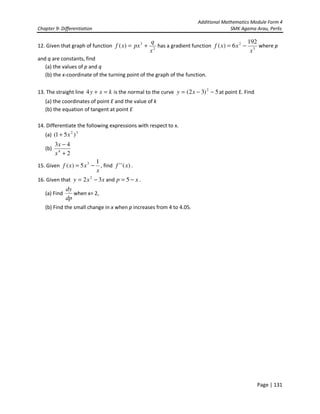
- 27. Additional Mathematics Module Form 4 Chapter 9- Differentiation SMK Agama Arau, Perlis Page | 131 12. Given that graph of function 2 3 )( x q pxxf += has a gradient function 3 2 192 6)( x xxf −= where p and q are constants, find (a) the values of p and q (b) the x-coordinate of the turning point of the graph of the function. 13. The straight line kxy =+4 is the normal to the curve 5)32( 2 −−= xy at point E. Find (a) the coordinates of point E and the value of k (b) the equation of tangent at point E 14. Differentiate the following expressions with respect to x. (a) 32 )51( x+ (b) 2 43 4 + − x x 15. Given x xxf 1 5)( 3 −= , find )('' xf . 16. Given that xxy 32 2 −= and xp −= 5 . (a) Find dp dy when x= 2, (b) Find the small change in x when p increases from 4 to 4.05.
-

GlazelleMatamorosa
Jul. 23, 2020 -
ErumFawwad
Jun. 8, 2020 -

meewah
Mar. 20, 2020 -
MonicaKoech
Feb. 14, 2020 -
ssuser1a1ddc
Feb. 8, 2020 -
AdeliaIsfihani
Feb. 3, 2020 -

norhaszuanimohdnasir
Jan. 21, 2020 -
nuratiqanatrahmansur
Oct. 25, 2019 -
MoganMarappan
Sep. 23, 2019 -
RachelSim13
Sep. 16, 2019 -
HaretzTj
Apr. 5, 2019 -
wawakz
Sep. 18, 2018 -
MuhdHanif11
Sep. 10, 2018 -
CrismaDaclan
Sep. 8, 2018 -
KhooMingJian
Sep. 7, 2018 -
EnRuLim3
Jul. 26, 2018 -
841040mun
Jul. 8, 2018 -
YueNaChuah
May. 28, 2018 -
JeremyNemo
Apr. 25, 2018 -
NajihaZaharudin
Apr. 20, 2018
Spm Additional Mathematics Formula List Pdf
Source: https://www.slideshare.net/ayiemdh/chapter-9-differentiation
Posted by: cobblacce1986.blogspot.com
0 Response to "Spm Additional Mathematics Formula List Pdf"
Post a Comment