

How To Create Login Page In Asp Net Using C#
In this article I will explain with an example, how to use the ASP.Net Login Control example with Database using C# and VB.Net.
The Login control makes use of Forms Authentication implemented using database in ASP.Net
Database
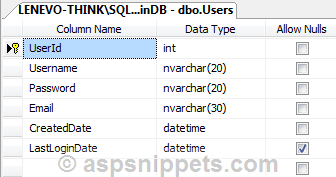
Note : The SQL for creating the database is provided in the attached sample code.
This example consists of two pages Login page (Login.aspx) using which the user will login and the Landing page (Home.aspx) which is the page user will be redirected after successful authentication.
Login Page
This is the login form which will do the following:-
1. Authenticate user by verifying Username and Password.
HTML Markup
The HTML markup consists of an ASP.Net Login control for which the OnAuthenticate event handler has been specified.
< form id ="form1" runat ="server">
< asp : Login ID = "Login1" runat = "server" OnAuthenticate = "ValidateUser"></ asp : Login >
</ form >

Namespaces
You will need to import the following namespaces.
C#
using System.Data;
using System.Configuration;
using System.Data.SqlClient;
using System.Web.Security;
VB.Net
Imports System.Data
Imports System.Configuration
Imports System.Data.SqlClient
Imports System.Web.Security
Stored Procedure to Validate the User Credentials
The following stored procedure is used to validate the user credentials, this stored procedure first checks whether the username and password are correct else returns -1.
If the username and password are correct but the user has not been activated then the code returned is -2.
If the username and password are correct and the user account has been activated then UserId of the user is returned by the stored procedure.
CREATE PROCEDURE [dbo].[Validate_User]
@Username NVARCHAR (20),
@Password NVARCHAR (20)
AS
BEGIN
SET NOCOUNT ON ;
DECLARE @UserId INT , @LastLoginDate DATETIME
SELECT @UserId = UserId, @LastLoginDate = LastLoginDate
FROM Users WHERE Username = @Username AND [Password] = @Password
IF @UserId IS NOT NULL
BEGIN
IF NOT EXISTS( SELECT UserId FROM UserActivation WHERE UserId = @UserId)
BEGIN
UPDATE Users
SET LastLoginDate =GETDATE ()
WHERE UserId = @UserId
SELECT @UserId [UserId] -- User Valid
END
ELSE
BEGIN
SELECT -2 -- User not activated.
END
END
ELSE
BEGIN
SELECT -1 -- User invalid.
END
END
Validating the User Credentials
The below event handler gets called when the Log In button is clicked. Here the Username and Password entered by the user is passed to the stored procedure and its status is captured and if the value is not -1 (Username or password incorrect) or -2 (Account not activated) then the user is redirected to the Home page using FormsAuthentication RedirectFromLoginPage method.
C#
protected void ValidateUser(object sender, EventArgs e)
{
int userId = 0;
string constr = ConfigurationManager.ConnectionStrings["constr"].ConnectionString;
using (SqlConnection con = new SqlConnection(constr))
{
using (SqlCommand cmd = new SqlCommand("Validate_User"))
{
cmd.CommandType = CommandType.StoredProcedure;
cmd.Parameters.AddWithValue("@Username", Login1.UserName);
cmd.Parameters.AddWithValue("@Password", Login1.Password);
cmd.Connection = con;
con.Open();
userId = Convert.ToInt32(cmd.ExecuteScalar());
con.Close();
}
switch (userId)
{
case -1:
Login1.FailureText = "Username and/or password is incorrect.";
break;
case -2:
Login1.FailureText = "Account has not been activated.";
break;
default:
FormsAuthentication.RedirectFromLoginPage(Login1.UserName, Login1.RememberMeSet);
break;
}
}
}
VB.Net
Protected Sub ValidateUser(sender As Object, e As EventArgs)
Dim userId As Integer = 0
Dim constr As String = ConfigurationManager.ConnectionStrings("constr").ConnectionString
Using con As New SqlConnection(constr)
Using cmd As New SqlCommand("Validate_User")
cmd.CommandType = CommandType.StoredProcedure
cmd.Parameters.AddWithValue("@Username", Login1.UserName)
cmd.Parameters.AddWithValue("@Password", Login1.Password)
cmd.Connection = con
con.Open()
userId = Convert.ToInt32(cmd.ExecuteScalar())
con.Close()
End Using
Select Case userId
Case -1
Login1.FailureText = "Username and/or password is incorrect."
Exit Select
Case -2
Login1.FailureText = "Account has not been activated."
Exit Select
Case Else
FormsAuthentication.RedirectFromLoginPage(Login1.UserName, Login1.RememberMeSet)
Exit Select
End Select
End Using
End Sub
Home Page
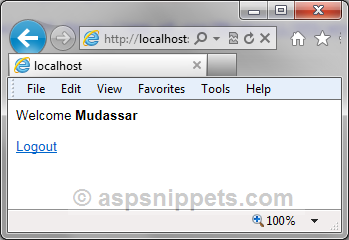
After successful login user will be redirected to this page.
HTML Markup
In this page I have made use of ASP.Net LoginName control to display the name of the Logged In user and LoginStatus control to allow user Logout.
< div >
Welcome
< asp : LoginName ID ="LoginName1" runat ="server" Font-Bold = "true" />
< br />
< br />
< asp : LoginStatus ID ="LoginStatus1" runat ="server" />
</ div >
Namespaces
You will need to import the following namespaces.
C#
using System.Web.Security;
VB.Net
Imports System.Web.Security
Verify whether User has Logged In
Inside the Page Load event, first we verify whether the User is authenticated using the IsAuthenticated property. If the user is not authenticated then he is redirected back to the Login page using FormsAuthentication RedirectToLoginPage method.
C#
protected void Page_Load(object sender, EventArgs e)
{
if (!this.Page.User.Identity.IsAuthenticated)
{
FormsAuthentication.RedirectToLoginPage();
}
}
VB.Net
Protected Sub Page_Load(ByVal sender As Object, ByVal e As System.EventArgs) Handles Me.Load
If Not Me.Page.User.Identity.IsAuthenticated Then
FormsAuthentication.RedirectToLoginPage()
End If
End Sub
Web.Config Configuration
You will need to add the following configuration in the Web.Config file in the < system.web > section.
< authentication mode = "Forms">
< forms defaultUrl = "~/Home.aspx" loginUrl ="~/Login.aspx" slidingExpiration ="true" timeout ="2880"></ forms >
</ authentication >
Downloads
How To Create Login Page In Asp Net Using C#
Source: https://www.aspsnippets.com/Articles/ASPNet-Login-Control-example-with-Database-using-C-and-VBNet.aspx
Posted by: cobblacce1986.blogspot.com
0 Response to "How To Create Login Page In Asp Net Using C#"
Post a Comment